
Cardiac Telemedicine: When "Time Is Myocardium" Takes on a New Meaning
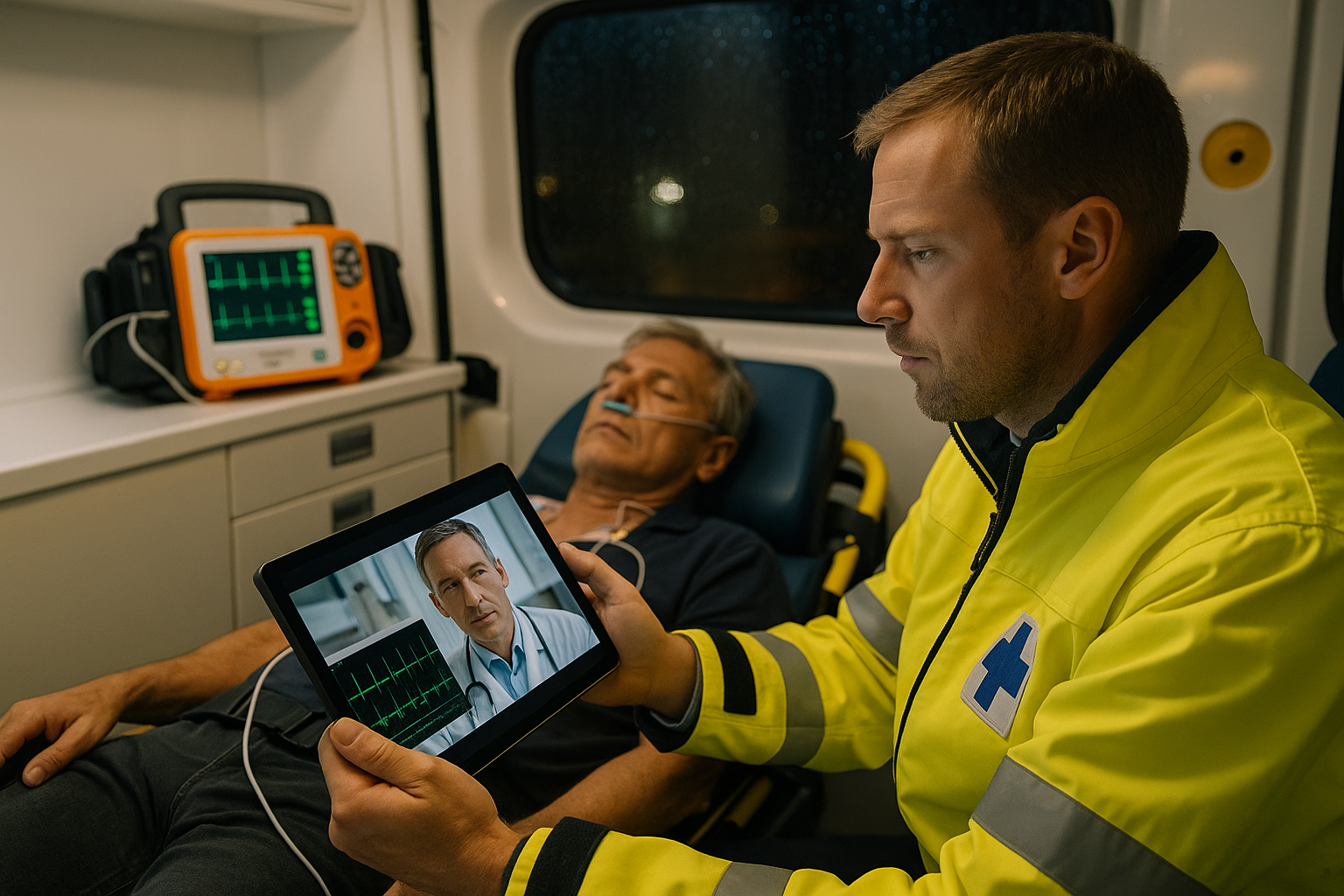
"Time is myocardium" - this ancient cardiology adage takes on a completely new meaning today in the era of telemedicine. As we write, in some Italian ambulance, a healthcare provider is transmitting an ECG in real time to a cardiologist located miles away, potentially saving a life.
When Technology Meets Urgency
Imagine this scene: it's a November night, it's raining, and an ambulance races toward the hospital. On board, a 58-year-old patient complains of severe chest pain. Until a few years ago, the medical team would have had to wait until arrival at the hospital for a definitive diagnosis. Today, thanks to telemedicine, that ECG is already being interpreted by an experienced cardiologist even before the ambulance arrives at the emergency department.
This is not science fiction, but the daily reality of modern emergency medicine, where telemedicine is radically transforming the management of acute coronary syndromes (ACS).
The Tools of the Future, Available Today
The technological revolution in ambulances is no longer a promise of the future, but a tangible reality that is saving lives every day. The tools that are redefining prehospital care include:
Connected Electrocardiographs: Devices that transmit ECG tracings in real time, allowing immediate interpretations by remote specialists.
Next-Generation Digital Stethoscopes: Capable of amplifying and filtering heart sounds, transmitting them with crystal-clear audio quality.
POCUS (Point-of-Care Ultrasound) Devices: Portable ultrasound machines that enable immediate assessments of cardiac function directly in the field.
In Italy, this technological evolution integrates perfectly with regional STEMI networks, creating an increasingly efficient and widespread emergency cardiac care system.
The Numbers That Change Everything
The statistics speak clearly and tell a success story that goes beyond the most optimistic expectations:
- -30% false positives: Diagnostic accuracy improves dramatically when the experienced eye of the cardiologist combines with advanced technology
- +18% PCI within recommended times: More patients receive percutaneous coronary intervention within optimal timeframes
- Reduced mortality: Telemedicine protocols show a significant reduction in mortality in acute coronary syndromes
These are not just numbers on a page: they represent lives saved, families that are not destroyed, futures that continue to exist.
Beyond Diagnosis: An Ecosystem of Care
Cardiac telemedicine excels particularly in managing complex cases that often challenge even the most experienced professionals:
Accurate and Timely Triage
Distinguishing precisely between STEMI, NSTEMI, and pericarditis can make the difference between life and death. Telemedicine offers that expert second opinion that can resolve the most insidious diagnostic doubts.
Optimization of Pharmacological Therapy
The ability to consult specialists in real time allows for more informed and personalized therapeutic decisions.
Management of Complex Cases
Patients with bundle branch blocks, pacemaker carriers, or those with particular cardiac anatomies benefit enormously from remote specialist consultation.
The Challenges That Still Await Us
Despite evident successes, the road to perfect cardiac telemedicine still presents some significant challenges:
Technological Limitations
False negatives remain a problem, as does limited coverage in some geographic areas. Signal quality can be compromised in emergency situations, and artifacts can confuse even the most advanced systems.
Organizational Challenges
Regional variability in protocol implementation and insufficient staff training represent obstacles that must be overcome through targeted investments and continuous education programs.
Integration of Point-of-Care Ultrasound
Portable ultrasound represents the natural completion of the diagnostic picture in telemedicine. Through assessment of segmental contractility, identification of pericardial effusions, and remote guidance of the examination, this technology offers a real-time window into the patient's heart, enabling increasingly precise and timely diagnoses.
The Future: Artificial Intelligence and Beyond
The horizon of cardiac telemedicine is rapidly expanding toward new technological frontiers. Decision support algorithms and real-time risk prediction promise to make clinical decisions even faster and more accurate.
Artificial intelligence will not replace human clinical judgment, but will enhance it, offering increasingly sophisticated analysis tools and reducing the margin of error in the most critical situations.
Practical Guide for Professionals
For EMS nurses operating on the front lines, cardiac telemedicine is based on three fundamental pillars:
- Quality ECG Acquisition: Diagnostic accuracy depends on the quality of the initial tracing
- Ultrasound Competence: The ability to effectively use POCUS devices
- SBAR Communication: Structured and precise communication with the hospital team
Take-Home Messages
✅ Use telemedicine especially for atypical STEMI and complex patients
✅ Always pay attention to artifacts and poor quality signals
✅ Prepare for the future: artificial intelligence will be increasingly present in daily clinical practice
Conclusion: An Ethical Imperative
Cardiac telemedicine represents much more than simple technological progress. It is an ethical imperative that requires us to use all available tools to ensure the best possible care for our patients.
In a world where every second counts, where the difference between life and death can be measured in minutes, telemedicine is no longer an option, but a necessity. It is tangible proof that when technology is placed in service of humanity, the results can be extraordinary.
The future of emergency cardiology is already here, in our ambulances, in our hospitals, in the hands of professionals who every day choose to embrace innovation to save lives. And this is only the beginning of a revolution that promises to completely redefine the way we think about and practice emergency medicine.
---
Bibliography
- Safavi-Naeini P, Saeed A, Kleber FX, et al. Artificial neural networks for ECG interpretation in acute coronary syndrome: A systematic review. Cardiol J. 2024;31(4):672–681. https://pubmed.ncbi.nlm.nih.gov/38526120/
- Lee S, Huang EY, Jhou MJ, et al. The Impact of Emergency Department Arrival Time on Door-to-Balloon Time and Clinical Outcomes of Acute STEMI. J Clin Med. 2023;12(6):2392. https://pubmed.ncbi.nlm.nih.gov/37048750/
- Alyeshmerni D, Charnigo RJ, Morley P, et al. Impact of POCUS on Prehospital Decision Making by HEMS Physicians. Prehosp Disaster Med. 2023;38(4):444–449. https://pubmed.ncbi.nlm.nih.gov/37170792/
- Roos JS, Bonaca MP, Kazi DS, et al. Machine learning for the diagnosis of ACS using a 12-lead ECG: A retrospective analysis. Am J Emerg Med. 2023;71:124–131. https://pubmed.ncbi.nlm.nih.gov/37060734/
- Stehli J, Duffy SJ, Burgess S, et al. Impact of Pre-Hospital Activation of STEMI on False Positives and Outcomes. Heart Lung Circ. 2022;31(3):374–381. https://pubmed.ncbi.nlm.nih.gov/35115245/
- Brunetti ND, Dellegrottaglie S, Lopriore C, et al. Telemedicine: The Future of Global STEMI Care. Curr Cardiol Rep. 2017;19(7):58. https://pubmed.ncbi.nlm.nih.gov/28508987/
- Kini AS, Vengrenyuk Y, Yoshimura T, et al. AI Interpretation of the Electrocardiogram: A State-of-the-Art Review. Curr Cardiol Rep. 2024;26(7):659–672. https://pubmed.ncbi.nlm.nih.gov/38869795/
- Tanguturi VK, Adabag S, Ternus B, et al. Telemedicine in Cardiology: Enhancing Access to Care and Improving Outcomes. Curr Cardiol Rep. 2024;26(7):721–730. https://pubmed.ncbi.nlm.nih.gov/38869796/
- European Society of Cardiology. 2023 ESC Guidelines for the Management of Acute Coronary Syndromes. Eur Heart J. 2023;44(38):3720–3826. https://www.escardio.org/Guidelines/Clinical-Practice-Guidelines/Acute-Coronary-Syndromes-ACS
- American Heart Association. 2023 AHA/ACC Guideline for the Management of ACS. Circulation. 2023;148(9):e9–e119. https://www.ahajournals.org/doi/10.1161/CIR.0000000000001168


