
It's 2:23 PM on a Saturday in January. The Valle d'Aosta EMS dispatch center receives the call: road traffic accident on the regional road to Courmayeur, a car against the guardrail. The driver, a man approximately 35 years old, is trapped in the vehicle.
When I arrive on scene – about 30 minutes after the accident – I find a conscious but confused patient, with obvious blunt chest trauma and suspected pelvic fracture. Blood pressure is 85/60, heart rate 125. The picture is clear: major trauma with suspected internal hemorrhage, high risk of trauma-induced coagulopathy.
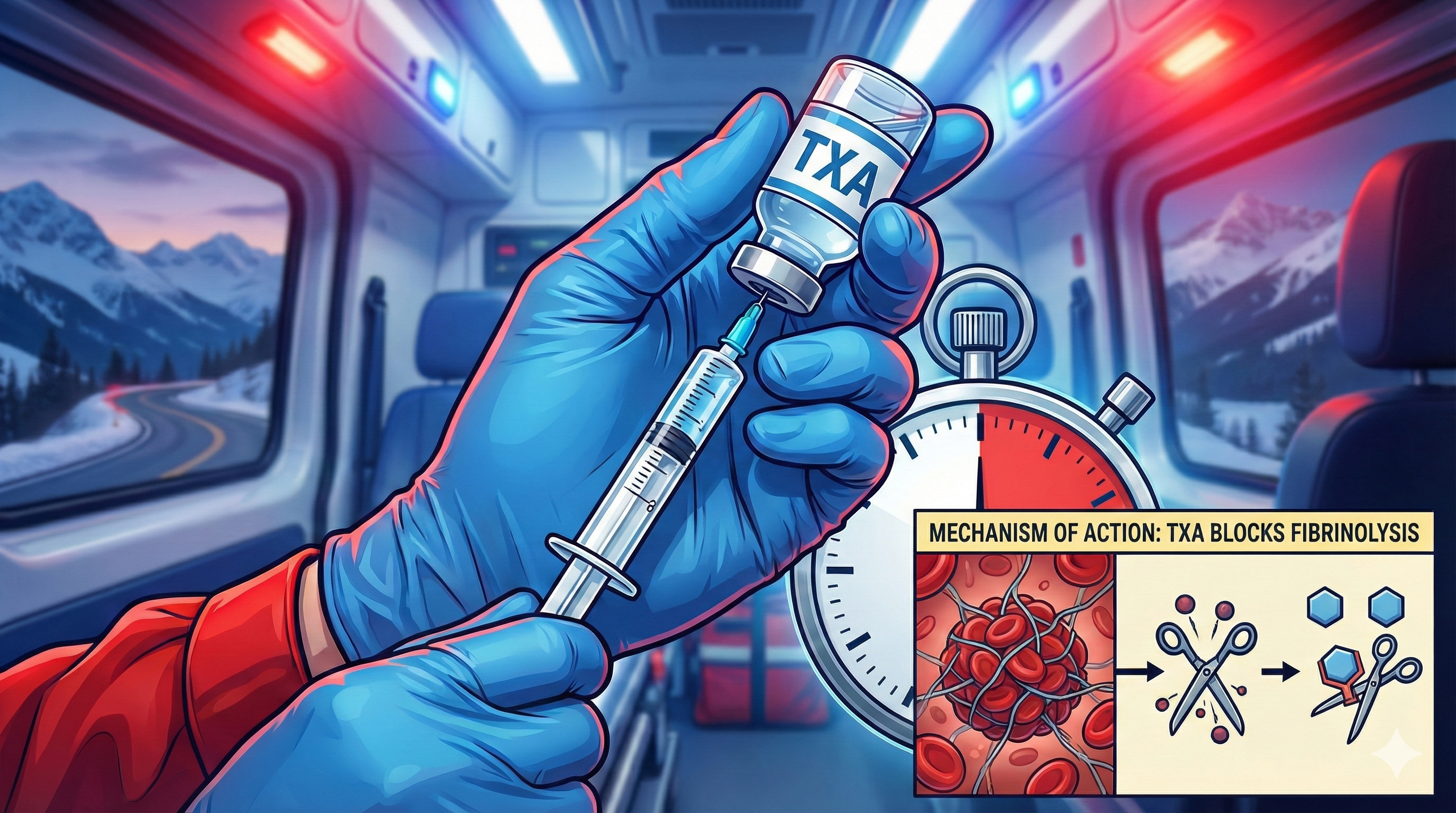
While my colleagues stabilize the spine and prepare for extrication, I do something that has now become automatic in these scenarios: 2 grams of tranexamic acid slow bolus. It's one of the first interventions, not an afterthought.
Why this urgency? Because a study just published in Annals of Emergency Medicine may have redefined the optimal time window – and not in the way we thought.
The study that changes the game
The PATCH-Trauma Trial was one of the most anticipated trials in the world of prehospital trauma. Conducted in Australia, New Zealand, and Germany, it enrolled 1,310 patients with major trauma and suspected coagulopathy. The exploratory analysis just published by Ali and colleagues focuses on a specific question: how much does time really matter?
The results are clear-cut. Administration of TXA within 90 minutes of trauma significantly reduced 28-day mortality: 17% in the TXA group versus 25% in the placebo group (adjusted RR 0.64, 95% CI 0.50-0.82). Beyond 90 minutes? No detectable benefit (RR 1.04, CI 0.74-1.47).
> Ninety minutes. CRASH-2 had identified a 3-hour window, with a favorable trend under one hour. STAAMP showed no global benefit, but secondary analyses suggested an advantage if administered very early. Now PATCH-Trauma points to 90 minutes as the threshold beyond which the benefit becomes uncertain.
Before we get too excited: the limitations
Those who know me know I never stop at the headline. This study has important strengths – times recorded to the minute, not estimated in hours as in CRASH-2, and high-performance EMS systems – but also significant limitations:
- It's a post-hoc analysis: the 90-minute cutoff was derived from the data, not pre-specified
- The study was not powered for this specific question
- 93% were blunt trauma – limited generalizability for penetrating trauma
- Possible temporal confounding: those who receive TXA earlier may differ systematically
That said, the data is consistent with STAAMP (maximum benefit within 1 hour) and with the direction already suggested by CRASH-2. It doesn't confirm the exact cutoff, but it reinforces the biological hypothesis: earlier is better.
Three studies, three windows: what they tell us together
Study | Analysis type | Suggested window | Setting | Notes |
|---|---|---|---|---|
CRASH-2 (2011) | Post-hoc | < 3 hours (favorable trend < 1 hour) | Hospital-based, predominantly variable-resource countries | Times estimated in hours; no precise cutoff in minutes |
STAAMP (2020) | Post-hoc | < 1 hour (no global benefit) | Prehospital, 4 US centers | Global benefit not significant; signal only in secondary analyses |
PATCH-Trauma (2026) | Post-hoc | < 90 minutes | Prehospital, advanced EMS systems (AUS/NZ/GER) | Times to the minute; high-risk TIC population |
The directional convergence is clear: all point toward "as soon as possible." The fact that the specific cutoffs don't coincide (3 hours, 1 hour, 90 minutes) suggests we're capturing statistical noise beyond the biological signal. But the principle holds.
Why time matters: the biology of coagulopathy
To understand why 90 minutes (or 60, or 120) can make the difference between life and death, we need to understand what happens in the blood of a traumatized patient. Trauma-induced coagulopathy (TIC) is not a static phenomenon – it's a dynamic process with two distinct phases, well described in the review by Gando and Hayakawa (J Intensive Care, 2017).
Early phase ("early TIC") – minutes-hours from trauma:
Shock and hypoperfusion cause a massive release of tPA (tissue plasminogen activator) from the endothelium. The result is a state of primary hyperfibrinolysis: clots form but are immediately lysed. This is the hemorrhagic phenotype, the window where TXA makes biological sense.
Late phase ("late TIC") – hours-days:
The system shifts toward a hypercoagulable state with fibrinolytic shutdown. Fibrin deposits in the microcirculation, multiorgan dysfunction. Here TXA could be neutral or theoretically harmful.
> The transition can occur in minutes or hours, depending on the severity of shock. This biologically explains why every minute counts: we're trying to intercept the hyperfibrinolytic window before the system changes phenotype.
The dosing question: 2 grams bolus vs 1+1
If timing is critical, the mode of administration also matters. The classic protocol (CRASH-2, civilian guidelines) calls for 1g bolus over 10 minutes followed by 1g infusion over 8 hours. The CoTCCC in 2020 changed course: 2g slow bolus IV/IO over 1 minute, without subsequent infusion.
Classic protocol (1g + 1g) | TCCC protocol (2g bolus) |
|---|---|
1g bolus over 10 min + 1g over 8h | 2g slow bolus over 1 min |
Requires prolonged infusion | Single complete administration |
Infusion often omitted or delayed | Guarantees complete dose |
Standard civilian guidelines | TCCC/military standard |
The evidence on 2g dosing comes primarily from the Rowell study (JAMA 2020), which however needs to be contextualized: it was a trial on moderate-severe TBI, not on general hemorrhagic trauma. In the subgroup with intracranial hemorrhage confirmed on CT, the 2g bolus showed 28-day mortality of 18% vs 28% for both 1g+1g and placebo. A UK retrospective study on 525 patients with hemorrhagic trauma (Marsden et al.) confirmed clinical equivalence between strategies, with mortality of 21% in all groups – but with the limitations of an observational design.
Important: the data on 2g bolus does not come from a large RCT on all types of trauma. The adoption by CoTCCC is based on a combination of limited evidence, pharmacological rationale, and logistical advantages in the tactical context.
The operational advantages of 2g bolus are evident:
- Eliminates the 8-hour infusion (which in the real world is often forgotten)
- Reduces cognitive load on scene
- Ensures the patient actually receives the entire dose
- Simpler in tactical, mountain, or resource-limited contexts
Safety note: the 2g bolus is associated with a slight increase in seizure-like activity (5% vs 2%), but without long-term neurological sequelae in available studies.
The state of affairs
✓ What we know | ? What we don't know |
|---|---|
The benefit of TXA decreases with time | The exact cutoff (60, 90, 120 min?) |
Early administration reduces mortality | Whether late TXA is neutral or harmful |
2g bolus is equivalent to 1g+1g for efficacy | Whether the data applies to penetrating trauma |
The 2g bolus has real logistical advantages | Optimal dose in different subgroups |
What it means for EMS
This data doesn't change the guidelines tomorrow – the authors themselves say so. Current official recommendations (EAST, ATLS, European trauma guidelines) continue to indicate TXA administration within 3 hours, with preference for early administration. There is not yet a universally accepted international recommendation for a precise 90-minute cutoff.
But the PATCH-Trauma data reinforces some practices that those working in the field already know:
1. TXA must be among the first things, not an afterthought
In patients with major trauma and suspected hemorrhage, TXA administration should not wait for "definitive" venous access or complete stabilization. If you have sufficient personnel, start TXA while stabilizing the patient.
2. The 2g bolus protocol makes operational sense
Especially in contexts like Valle d'Aosta – long transport times, limited resources, mountain scenarios – the single bolus eliminates variables and guarantees the dose. It's not yet the Italian civilian standard, but it's reasonable and supported.
3. It's never "too early"
If the patient meets the criteria (major trauma, suspected significant hemorrhage, shock), there's no reason to wait. The pathophysiology and evidence point in the same direction.
Take-home messages
- The optimal window for TXA in trauma may be narrower than indicated by current guidelines (3 hours): PATCH-Trauma suggests that the benefit is maximal within 90 minutes and uncertain beyond
- The data is consistent with pathophysiology (early hyperfibrinolysis) and with other studies (STAAMP, CRASH-2)
- The 2g bolus dosing (TCCC protocol) is equivalent in efficacy and has operational advantages in prehospital care
- Guidelines haven't changed yet, but the direction is clear: earlier is better
- When in doubt, administer early. There is no "too early" in hemorrhagic trauma
The patient from the Courmayeur accident? Arrived in the operating room 58 minutes after my TXA. Hemostasis procedure for splenic laceration, 4 units of packed red blood cells. Discharged after 12 days with fractures healing. Impossible to know how much that early bolus mattered – but the literature suggests it may have made the difference.
References
- Ali A, Gruen RL, Bernard SA, et al.
Tranexamic acid timing and mortality impact after trauma.
Ann Emerg Med. 2026;87:83-89.
doi:10.1016/j.annemergmed.2025.06.609 - CRASH-2 Trial Collaborators.
Effects of tranexamic acid on death, vascular occlusive events, and blood transfusion in trauma patients with significant haemorrhage (CRASH-2): a randomised, placebo-controlled trial.
Lancet. 2010;376(9734):23-32.
doi:10.1016/S0140-6736(10)60835-5 - Roberts I, Shakur H, Afolabi A, et al.
The importance of early treatment with tranexamic acid in bleeding trauma patients: an exploratory analysis of the CRASH-2 randomised controlled trial.
Lancet. 2011;377(9771):1096-1101.
doi:10.1016/S0140-6736(11)60278-X - Guyette FX, Brown JB, Zenati MS, et al.
Tranexamic acid during prehospital transport in patients at risk for hemorrhage after injury: a double-blind, placebo-controlled, randomized clinical trial (STAAMP).
JAMA Surg. 2020;156(1):11-20.
doi:10.1001/jamasurg.2020.4350 - Drew B, Auten JD, Cap AP, et al.
The use of tranexamic acid in Tactical Combat Casualty Care: TCCC proposed change 20-02.
J Spec Oper Med. 2020;20(3):36-43. - Rowell SE, Meier EN, McKnight B, et al.
Effect of out-of-hospital tranexamic acid vs placebo on 6-month functional neurologic outcomes in patients with moderate or severe traumatic brain injury.
JAMA. 2020;324(10):961-974.
doi:10.1001/jama.2020.8958 - Marsden M, Benger J, Sherwood N, et al.
A comparative analysis of tranexamic acid dosing strategies in traumatic major hemorrhage.
J Trauma Acute Care Surg. 2024.
doi:10.1097/TA.0000000000004137 - Gando S, Hayakawa M.
Pathophysiology of trauma-induced coagulopathy: disseminated intravascular coagulation with the fibrinolytic phenotype.
J Intensive Care. 2017;5:14.
doi:10.1186/s40560-016-0200-1