Part 2: Practical Applications, Training, and the Role of AI
Continuing the interview with Dr. Leonardo Capitanio Regional Representative for Italy of Counter-Terrorism Medicine Europe
Introduction
After exploring the fundamentals of Counter-Terrorism Medicine in the first part of this interview, we now delve into concrete applications in prehospital medicine, the specific challenges of the Italian context, and especially the innovative role that artificial intelligence can play in this field.
From Theory to Practice: Concrete Applications of CTM
Simon: Can you give us some concrete examples of how CTM is applied in prehospital practice?
Leonardo: "CTM allows us to reinterpret prehospital practice activities differently, integrating concepts of tactical medicine and operator safety, and ultimately making us more aware in our daily work."
The Tourniquet: From Military to Civilian Practice
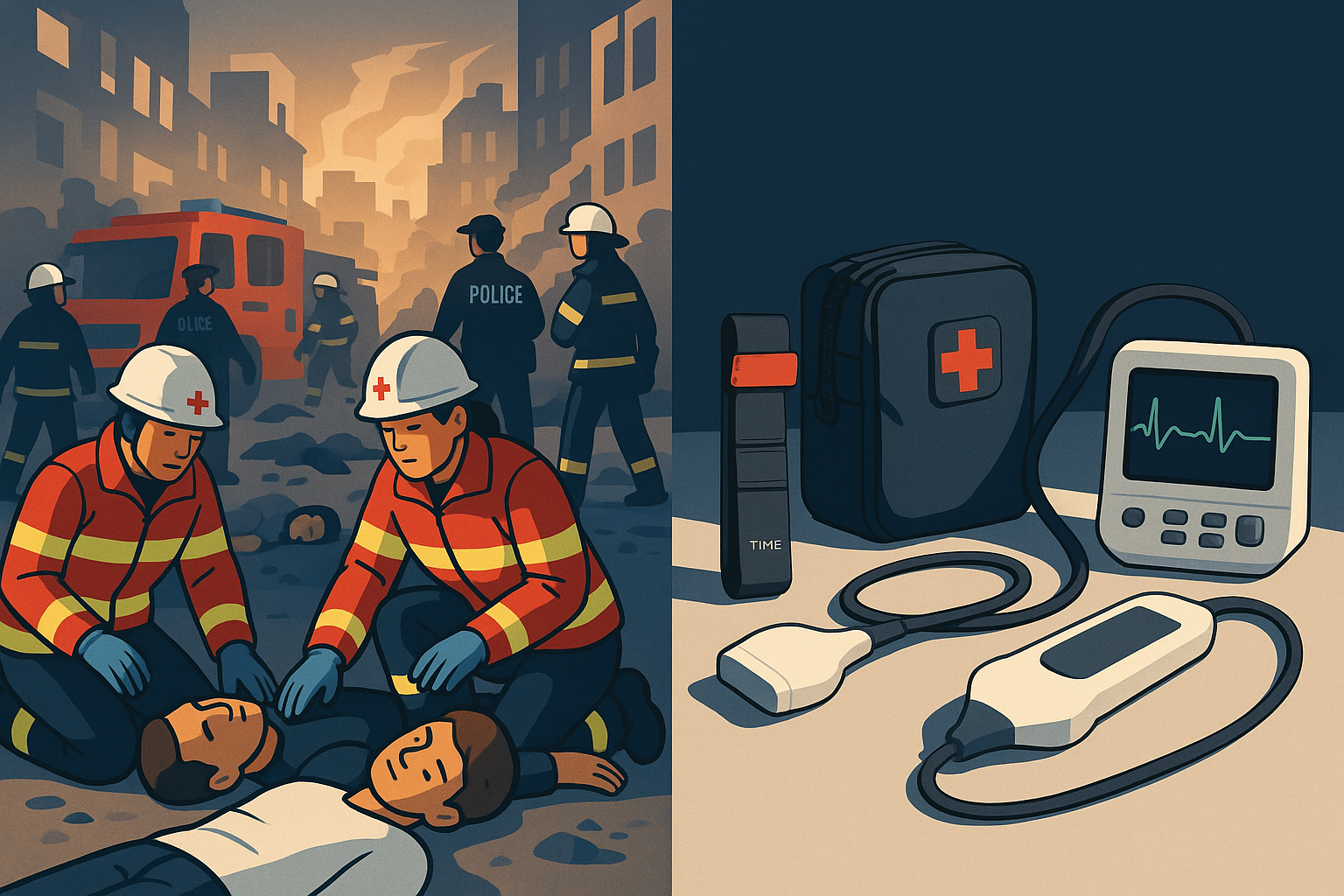
"A classic example is the use of the tourniquet," Leonardo explains. "It originated in the military setting, but today it also finds application in civilian trauma, often with better outcomes thanks to shorter application times."
The tourniquet represents a perfect case of technological transfer from military to civilian medicine. In the military context, it was developed to manage massive hemorrhages from gunshot wounds or explosives, in hostile environments where delays in rescue make rapid hemorrhage control by the operator necessary. In civilian application, however, it is used in trauma resulting from road or industrial accidents, traumatic amputations, and uncontrollable arterial hemorrhages of the limbs.
Shorter transport times allow for better outcomes in the civilian context, but the real breakthrough will come with widespread bystander training, along with bleeding control kits accessible to the public.
Decontamination and Chemical Agent Management
Another significant example concerns decontamination procedures. "Studying procedures designed for chemical agents in complex scenarios helps manage more common situations more effectively," Leonardo observes.
Familiarity with protocols and PPE for "riot agents," broadly speaking, proves useful even for multiple exposures to pepper spray, which can trigger a significant deployment of resources if used on a crowd in an enclosed environment. Similarly, conscious management of scene safety can become crucial in approaching carbon monoxide poisoning in enclosed spaces.
"The skills developed for CBRN (Chemical, Biological, Radiological, Nuclear) scenarios prove valuable even in conventional toxicological emergencies," Leonardo emphasizes.
Healthcare Infrastructure Security
An often overlooked but crucial aspect concerns the vulnerability of healthcare facilities themselves.
Leonardo: "Reflection on attacks on healthcare infrastructure reminds us how much these have become symbolic and tactical targets. In ordinary prehospital settings, this can translate into greater attention to the security of stations, access routes, and personnel."
Practical applications include risk assessment at EMS stations, development of security protocols for access to critical areas, coordination with law enforcement in high-risk situations, and management of assaults on healthcare personnel.
The Italian Context: Potential and Gaps
Simon: How is CTM developing in Italy? What training gaps do you see in our system?
Leonardo: "I see great interest from Italian colleagues, who represent the largest group within CTM-E. At the same time, fortunately not having recent experience of significant internal terrorism from a healthcare perspective, it is more difficult to develop true operational field competence."
Challenges of the Italian System
Leonardo identifies three main critical issues.
- The first concerns the lack of inter-agency exercises: "Inter-agency exercises are not frequent in most settings," he observes. This limits operational integration between healthcare workers, law enforcement, and firefighters, compromises understanding of respective roles and protocols, and reduces opportunities for training in realistic scenarios.
- The second critical issue is the absence in training curricula: "In the training pathways of prehospital operators, there is still no structured space for CTM understood as part of disaster medicine." Currently in Italy, there is no mandatory CTM module in specialty schools, presence in prehospital emergency qualification courses is limited, and integration in emergency medicine masters is scarce. The only positive signal is the growing interest from professionals in TECC training centers.
"Certainly integration would be useful," Leonardo suggests, "perhaps as a TECC course within prehospital emergency qualification, if not directly in specialty schools." - The third challenge concerns the fragmentation of the EMS system: "Having an emergency prehospital system fragmented across the national territory doesn't help." Regional differences create heterogeneous operational protocols, difficulties in inter-regional coordination, and limited economies of scale in training.
Essential Skills for the Prehospital Emergency Physician
Simon: What specific skills should a prehospital emergency physician have to be prepared for CTM scenarios?
Leonardo: "I believe that a prehospital emergency physician should first consolidate some of their basic skills, particularly relevant from a CTM perspective."
Leonardo identifies four fundamental areas. Scene safety requires the ability to identify residual threats, conduct rapid risk assessment, and ensure protection of the healthcare team. Multi-patient management includes triage in poorly defined scenarios, adaptation to START/SMART protocols, and coordination with other actors involved. Advanced trauma skills include familiarity with atypical injury patterns, management of blast injuries and hemorrhagic shock, and emergency surgery maneuvers. Finally, operational integration requires understanding security dynamics, effective communication with law enforcement, and the ability to adapt to dynamic scenarios.
Multidisciplinary Collaboration: The Key to Success
Simon: How important is collaboration with law enforcement, firefighters, and civil protection?
Leonardo: "I believe it is fundamental. Unfortunately, as I was saying, inter-agency simulations are not that frequent."
In a terrorist scenario, effective response requires tight coordination between different actors. Law enforcement handles threat neutralization, scene clearance, and identification of safe zones. Firefighters manage USAR (Urban Search and Rescue) operations, CBRN response, and victim extraction. The EMS system and healthcare workers focus on triage and treatment, evacuation coordination, and interface with hospitals. Civil Protection provides logistical support, manages population flows, and handles public communication.
The solution? "More exercises and events," Leonardo hopes, "more awareness, up to the structured and reasoned inclusion of CTM in prehospital curricula."
Artificial Intelligence in CTM: A Revolution on the Horizon
As a beta tester of EMSy, Leonardo offers a privileged perspective on the integration between AI and Counter-Terrorism Medicine.
AI in Training: Realistic Simulations
Simon: How do you see the integration of AI platforms in preparation for terrorist scenarios?
Leonardo: "AI is, and will increasingly be, a central tool in our work, and training is one of the contexts where it can have an immediate concrete impact."
In training, the applications are multiple. Regarding mass casualty simulations, Leonardo explains: "In mass casualty simulations, AI can be used to create realistic clinical conditions for hundreds of patients, and make them evolve based on interventions performed in various phases of rescue." This means infinitely repeatable and modifiable scenarios, cost reduction compared to traditional exercises, immediate feedback on decisions, and the ability to test different strategies.
AI can also contribute to real-time logistical optimization: "It can help optimize logistics in real time, integrating information on resources, evacuation routes, and hospital availability."
A particularly useful application concerns structured memory support: "It can be useful as structured memory support for the operator: from triage systems like START and SMART, to clinical protocols (I'm thinking for example of Toxidrome Recognition in Chemical Weapons Attacks by Ciottone), to pediatric dosages." The advantage? "Everything on a single quick-access platform, and above all, capable of providing precise feedback on individual choices."
AI in Operational Response: Real-Time Support
Simon: In a real terrorist scenario, where decisions must be made in fractions of a second, how useful can an AI system be?
Leonardo: "The integration of AI in operational response to terrorist scenarios has obvious potential."
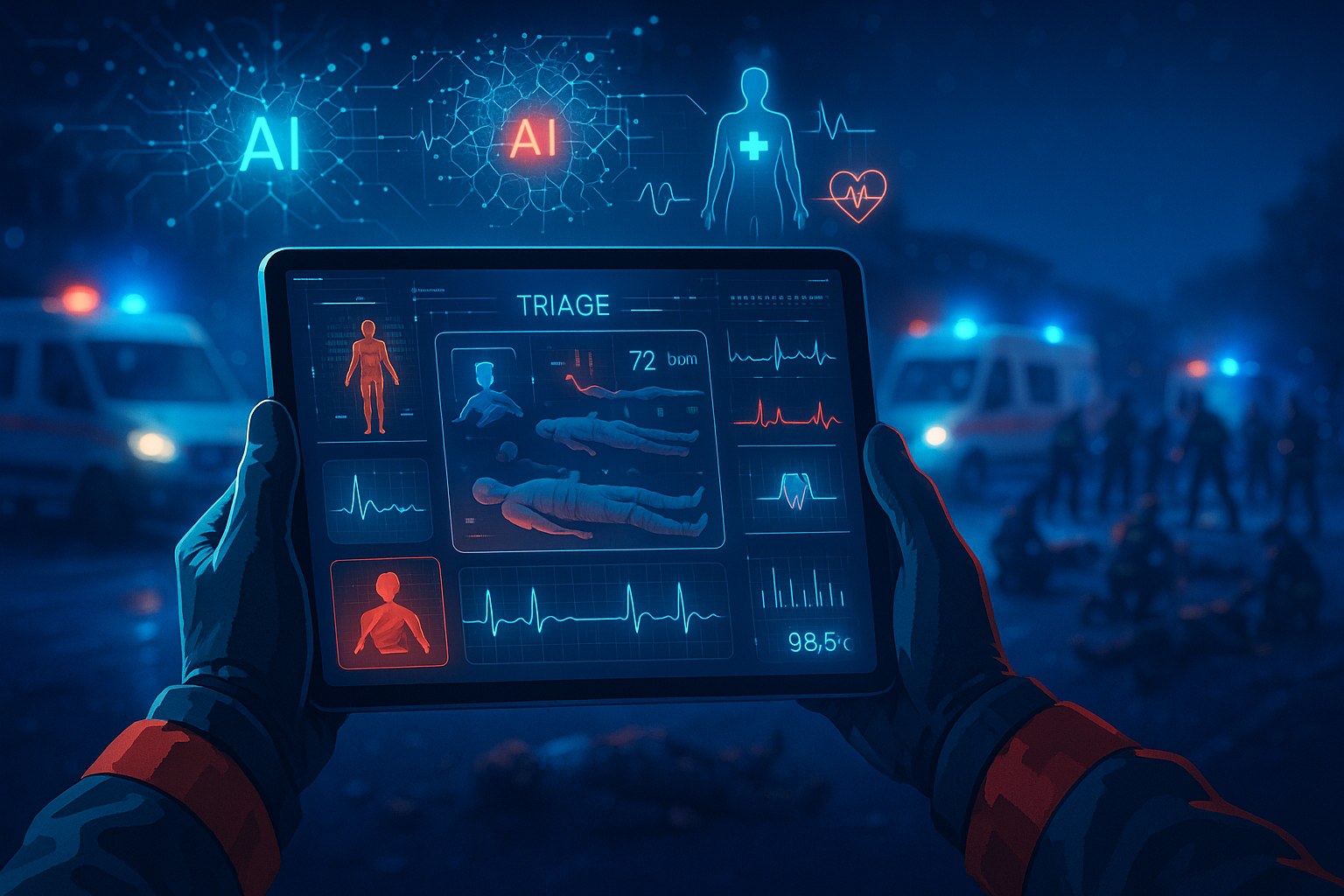
Concrete applications range from assisted triage, with rapid analysis of multiple vital parameters, suggestion of priorities based on available resources, and dynamic tracking of patient evolution, to resource allocation optimization, monitoring hospital reception capacity in real time, optimizing ambulance routing based on traffic and availability, and predicting the need for additional resources.
Additional applications include precise handoffs, with automatic documentation of interventions, structured clinical summary, and patient pathway traceability. But above all, AI can support cognitive load management: "It can do all this faster than personnel can manually integrate dozens of heterogeneous inputs, especially under conditions of extreme cognitive and emotional load," Leonardo emphasizes.
AI Limitations: Where the Human Remains Irreplaceable
Leonardo maintains a balanced approach, highlighting real critical issues.
Leonardo: "The limitations are equally evident. First and foremost, AI depends on data quality, and if inputs are incomplete or contradictory, so are its indications."
Critical vulnerabilities are multiple. In a chaotic post-attack scenario, connectivity problems can be significant: overloaded or damaged cellular networks, compromised network infrastructure, power blackouts.
Then there are cybersecurity problems: "There are cybersecurity problems, amplified by possible manipulations in hostile contexts." Risks include targeted cyberattacks on rescue systems, disinformation fed by manipulated data, and sabotage of communications.
Finally, the question of decision-making responsibility: "For this reason, the role of AI cannot be substitutive: in a terrorist scenario, responsibility remains with the human operator."
The Ideal Model: AI as an Amplifier
Leonardo proposes a pragmatic approach: "The system must be designed to work offline as well, and when necessary in analog mode. In any case, it will take time, but I am convinced it can become a significant capacity amplifier."
The guiding principles are clear: AI must be a decision support tool, not a substitute; degraded offline mode must be guaranteed; manual override must always be available; continuous operator training is essential; clinical validation must be rigorous.
EMSy and CTM: A Concrete Example
As a beta tester of the EMSy platform, Leonardo identifies immediate applications. EMSy Arena for CTM training can offer quizzes on CBRN scenarios, TECC (Tactical Emergency Casualty Care) protocols, toxidrome recognition, and pediatric antidote dosages in emergencies. The AI Assistant can provide operational support with quick access to PHTLS and TECC guidelines, decontamination protocols, information on antidotes and CBRN agent management, and anatomical references for trauma procedures.
The Future of CTM: Challenges and Opportunities
Simon: Looking to the future: what do you think will be the next challenges of Counter-Terrorism Medicine?
Leonardo: "The main challenge will be finding space for CTM within public health systems under increasing economic pressure."
Emerging Threats
"Future scenarios will probably be increasingly hybrid," Leonardo predicts. Cyberattacks on healthcare infrastructure are already a reality in Italy. Chemical and biological agents of new design represent an evolving threat. Traditional threats are globally increasing, and coordinated disinformation can amplify chaos.
CTM will need to integrate into systems already at their limit, characterized by restricted healthcare budgets, staff shortages, obsolete infrastructure, and bureaucratic complexity.
Technological Developments
Leonardo: "On the technological development front, I think yes, we will see progressive integration between portable diagnostic tools and decision support systems."
A particularly interesting perspective concerns POCUS + AI integration: "There are already prospects for using AI in POCUS, which allow reducing operator dependence."
Concrete applications include automatic identification of B-lines, ejection fraction assessment, pneumothorax detection, and guidance for correct technical execution. The advantages in CTM scenarios are evident: rapid diagnostics even for less experienced operators, reduction of errors from stress and fatigue, objective documentation of findings, and possibility of telemedicine with specialized centers.
Message to Colleagues: Why Be Interested in CTM
Simon: A final message for young colleagues in prehospital emergency medicine?
Leonardo: "I believe it's worth being interested in CTM because it is above all a different way of reading our daily work. It means better understanding how mass casualty incidents work, how to protect operators, how to integrate clinical skills with operational awareness."
The advantages are concrete on multiple fronts. For careers, it is a young field with space for original contributions, research and publication opportunities, and access to an international professional network. For clinical practice, it means greater operational safety, advanced trauma skills, and situational awareness. For personal growth, CTM represents a stimulating multidisciplinary discipline that integrates medicine, security, and geopolitics, allowing contribution to system preparedness.
The Vision for Italy
"For Italy, I hope we continue on this growth trajectory: more exercises and events, more awareness, up to the structured and reasoned inclusion of CTM in prehospital curricula," Leonardo concludes.
"The challenge now is to transform it into a recognized discipline, keeping it updated and aligned with the real needs of work in the field."
Conclusions: Preparing Today to Respond Tomorrow
Counter-Terrorism Medicine represents much more than preparation for extreme scenarios. It is an integrated approach that improves daily practice with advanced trauma skills, increases the safety of healthcare operators, integrates different disciplines (medicine, security, logistics), leverages new technologies (AI, POCUS, telemedicine), and prepares the healthcare system for future threats.
Integration with artificial intelligence opens revolutionary scenarios, but always maintaining the centrality of the human factor. As Leonardo emphasizes: "It will be fundamental to work on continuous operator training, to make new technologies our own without losing the centrality of the human factor."
The time to act is now: not out of fear, but out of professional responsibility toward the patients we might find ourselves rescuing in extreme scenarios.