Part 1: Fundamentals and Perspectives
Interview with Dr. Leonardo Capitanio Regional Representative for Italy of Counter-Terrorism Medicine Europe
Introduction: A Context of Structural Threat
In a global context where the terrorist threat remains a structural variable, healthcare systems are also called upon to question their level of preparedness. Alongside disaster medicine and traditional emergency medicine, a discipline still little known in Italy but increasingly relevant is emerging: Counter-Terrorism Medicine (CTM).
To explore this topic, we interviewed Dr. Leonardo Capitanio, a prehospital emergency physician contracted with AUSL Ferrara - 118 Emilia Est and Regional Representative for Italy of Counter-Terrorism Medicine Europe (CTM-E).
Who is Leonardo Capitanio
Leonardo Capitanio is a physician with experience in complex operational contexts, gained through:
- Search and rescue activities in the Mediterranean
- Prison medicine
- Border areas
- Emergency and humanitarian medicine scenarios in Italy and abroad
He is currently in a general practice residency and EURIPA member. His educational background includes level II Master's degree in:
- Global Health
- Emergency Medicine
- Geopolitics and Global Security
- Pediatric and Neonatal Emergencies
He is the author of publications on Aspis Medical and has completed several advanced courses in ultrasound and prehospital care. Since March 2025, he has held the role of Regional Representative for Italy of CTM-E.
From the Field to CTM: A Natural Path
Simon: Leonardo, can you tell us how you came to Counter-Terrorism Medicine?
Leonardo: "I came to CTM quite naturally: after a master's degree in Geopolitics and Global Security, I looked for a field that would connect these topics with my operational reality as a prehospital emergency physician, and CTM offered me exactly this intermediate space. At that time, CTM-E had just been founded: I contacted the founder, George Tataru, to offer a contribution, and from there my role as Regional Representative for Italy was born."
Field experience shaped this choice decisively. As Leonardo explains:
"Field experiences have all offered me useful perspectives, and CTM was a way to organize them. Consider, for example, the role that some prisons have played in radicalization, the function of SAR and EMS systems in disaster management, or the entire chapter on attacks on healthcare infrastructure in conflict zones."
What is Counter-Terrorism Medicine
Simon: For those who don't know it yet: what exactly is Counter-Terrorism Medicine and what are the specific challenges a physician faces in terrorist scenarios?
Leonardo: "CTM is the sector of disaster medicine that deals with the health impacts of terrorism. Unlike 'traditional' emergencies (of any scale), it starts from the assumption that the event is intentional, designed to maximize casualties and psychological impact on survivors, possibly also targeting responders, saturating resources, and creating information chaos."
The Unique Challenges of Counter-Terrorism Medicine
Counter-Terrorism Medicine presents operational and clinical characteristics that radically distinguish it from traditional disaster medicine:
1. Unconventional Injury Patterns
Healthcare providers must deal with injuries caused by complex and sometimes combined mechanisms:
- Firearms
- Explosives
- Edged weapons
- Vehicles (the so-called TARMAC - Targeted automobile ramming mass casualty)
- Chemical or biological agents
2. Scene Management in the Presence of Active Threat
CTM scenarios are characterized by unique dynamics compared to accidental emergencies:
- Multi-patient management with fragmented and changing information
- Possible persistence of the threat even during rescue operations
- Risk of secondary attacks directed at responders (the "Double-Tap" phenomenon)
- Need for close and continuous inter-agency coordination with law enforcement
3. The Intentional Factor
Unlike accidental emergencies, the terrorist event is the result of deliberate planning. As Leonardo emphasizes:
"The problems are those typical of disaster medicine, but amplified by the intentional factor and the need to further integrate health preparedness with security considerations."
CTM vs Traditional Emergencies: Key Differences
A terrorist attack does not follow the same logic as a multiple casualty incident or natural disaster. It is planned. This radically modifies the operational, clinical, and decision-making approach.
Aspect | Traditional Emergency | Terrorist Scenario |
|---|---|---|
Nature of event | Accidental | Intentional |
Injury mechanisms | Relatively predictable | Complex, unusual, and often combined |
Scene security | Generally secured before intervention | Possible residual threat, secondary attacks |
Coordination | Standard | Need for structural integration with law enforcement |
Psychological burden | High | Extreme, disinformation |
Why Should a Prehospital Emergency Physician Be Interested in CTM?
The question arises naturally: in Italy, fortunately, we have no recent experience of large-scale terrorism. Why then invest time and resources in this training?
Leonardo offers an illuminating perspective:
"CTM allows us to reinterpret prehospital practice activities differently, integrating concepts of tactical medicine and operator security, and ultimately making us more aware in daily practice."
Direct Applications in Non-Terrorist Scenarios
CTM competencies have much broader applications than might appear:
- Scene security: threat assessment and team protection
- Multi-patient management: organization in chaotic scenarios with fragmented information
- Advanced trauma management: competencies on complex injury patterns
- Inter-agency coordination: effective collaboration with law enforcement and other actors
From Operational Experience to Scientific Production
One of the defining aspects of CTM-E is the attempt to transform research and field experience into shared conceptual and operational tools.
Leonardo's publications on Aspis Medical address some central themes of the discipline:
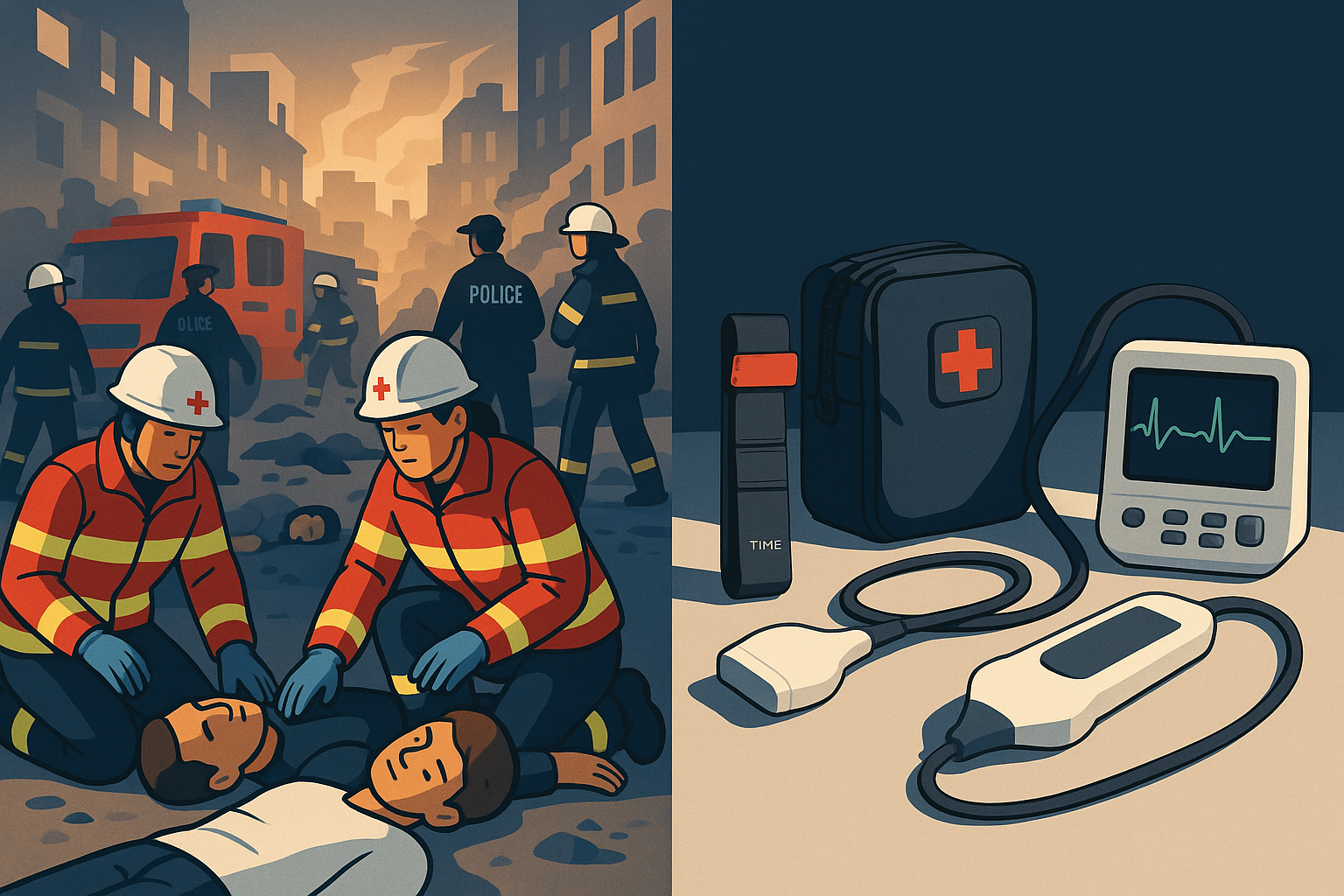
- POCUS in critical scenarios: point-of-care ultrasound as a rapid diagnostic tool
- Tourniquets: from military application to civilian use
- Pepper spray exposure: management of mass intoxications
- Targeting of healthcare facilities: how to protect personnel and infrastructure
The Operational Value of Research
For example, "reflection on attacks on healthcare infrastructure reminds us how much these have become symbolic and tactical targets. In the ordinary prehospital setting, this can translate into greater attention to the security of stations, access routes, and personnel, aspects that then become useful with respect to assaults in a broader sense".
The CTM-E Group: A Growing European Network
Counter Terrorism Medicine Europe represents a rapidly expanding professional network. As Leonardo recounts:
"I see great interest from Italian colleagues, who within CTM-E represent the largest group."
This data is significant: despite limited direct operational experience with terrorist events, Italian professionals recognize the strategic value of this training.
What CTM-E Offers
- International networking with professionals from different European countries
- Sharing of best practices and validated protocols
- Continuous updates on emerging threats and technologies
- Live events and inter-agency exercises, in planning
Conclusions: A Discipline for the Present, Not Just the Future
Counter-Terrorism Medicine is not preparation for hypothetical future scenarios. It is a discipline that enriches the daily practice of the Prehospital Emergency Physician, offering conceptual and operational tools applicable in multiple contexts.
As Leonardo highlights:
"We are still in an initial phase, but the direction seems positive to me, even in the absence of events that would force a quantum leap."
The Italian approach to CTM is distinguished by being proactive rather than reactive: building competencies before they become urgently necessary, integrating security and clinical care as complementary elements of modern medical practice.
Continue Reading
In the next article, we will explore in depth:
- The practical applications of CTM in Italian prehospital medicine
- The training gaps in our system
- The revolutionary role that artificial intelligence can play in preparedness and response to terrorist scenarios